
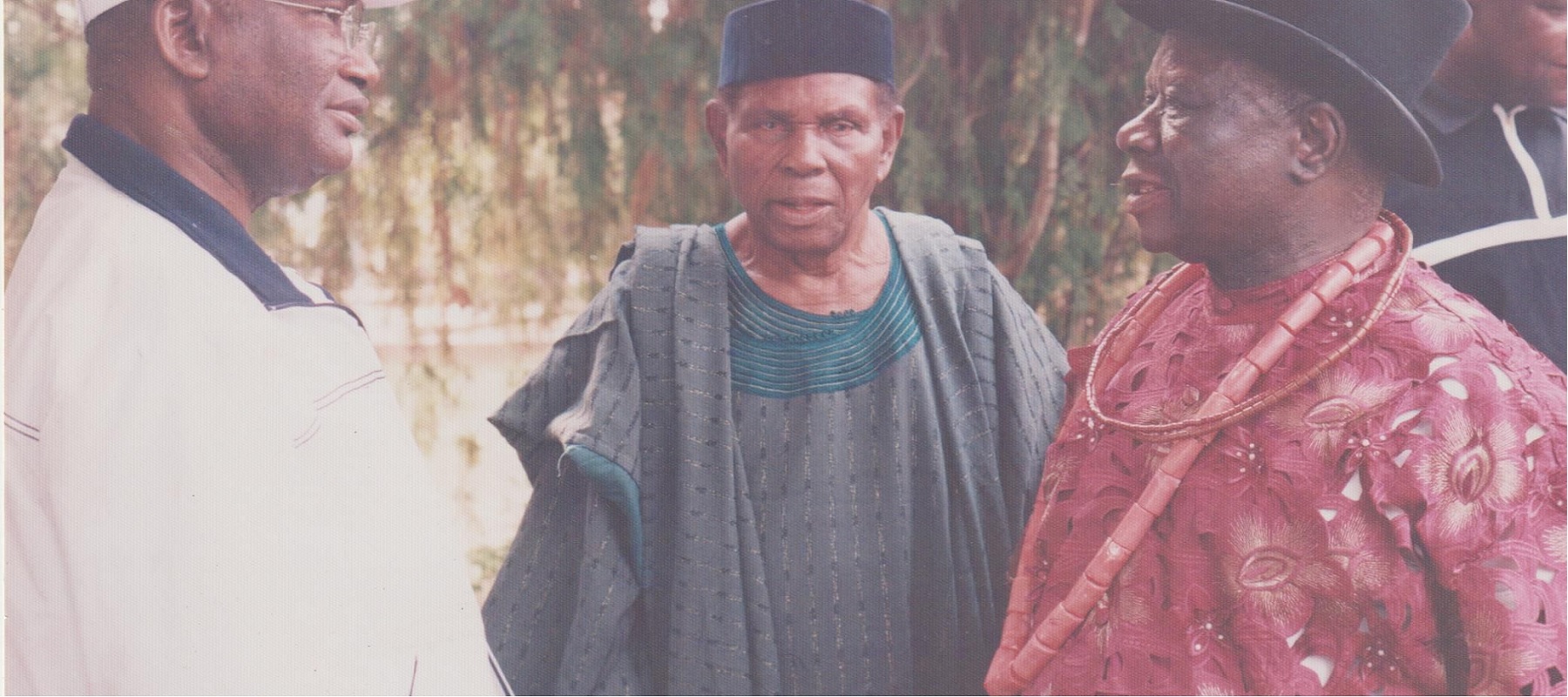
CHIEF (SENATOR) EKPEMORIRI AKHAGBEMHE LAMAI (O.O.N)
The political enigma, the phenomenon, the quintessential politician and foremost leader of Edo North politics was born in 1915 to the illustrious family of Akhagbemhe Lamai Oyieka of Ape-Osakhu kindred of Ivioramhe quarters, Fugar and Madam Enesomhi Lamai (nee Agiegba) of Iviokpisa, Agenebode. His father, Akhagbemhe was a great warrior and community leader par excellence whose principled stand on to the desecration of our societal values and ethos by the Native Authority led to the popular revolt of 1908 by the Avianwu people.
EARLY LIFE
Chief E.A Lamai started his elementary education in 1921 at Owerri under the guardianship of his uncle, Chief Agbomhekhe Lamai. He successfully completed his primary school education in 1928 and armed with the standard six leaving certificate, the young Lamai enrolled at the prestigious Owerri Provincial Teacher Training College. His exceptionally brilliant academic performance earned him many laurels and endeared him to the school authorities. Upon his graduation in 1933, he taught for several years in the same institution at Owerri before relocating to Minna, now capital of Niger State. His exemplary conduct in the classroom, his uncanny ability to inculcate the virtues of self-discipline in his students and his relentless advocacy for western education upon his relocation to Minna, a predominantly Muslim community endeared him to the colonial authorities.
Chief Lamai was deeply involved in Boy’s brigade, a voluntary organization committed to rendering qualitative selfless service to the people and the inculcation of self-discipline in youths. As a result of his commitment to the propagation of the ideals of the brigade, chief Lamai was elected Deputy Commissioner of the organization for eastern region, a position he retained upon his relocation to the northern region in 1947.
HIS POLITICAL LIFE
Chief E.A Lamai was a founding member of the National Council for Nigerian Citizens (NCNC) led by the indefatigable Nationalist, Herbert Macaulay. As an admirer of Dr. Nnamdi Azikwe, he joined the Zikist Movement where he cut his political teeth. The movement was generally regarded as the revolutionary arm of the NCNC and it was irrevocably committed to the independence of Nigeria and the total liberation of Africa from the vestiges of colonialism.
As a reward for his unwavering commitment to the pursuit of the ideals of the NCNC, the Party National Hierarchy in 1952 appointed Chief Lamai, the Organizing Secretary for Afemai Division (Edo North). In this position, Chief Lamai’s innate organizational prowess and his excellent articulation of issues became manifest. The Action Group AG, the hitherto dominant Party in Afemai was relegated to the background as a result of Chief Lamai’s efforts and NCNC became the dominant party.
In the countdown to the 1954 federal elections to the House of Representatives, Chief Lamai as a grassroot politician with ears on the ground, recommended Chief (Barrister) J. M. Udochi as the Party’s candidate but the party’s national hierarchy in sheer display of cronyism insisted on the Candidature of Alhaji Ja Usman from Agbede, a Lagos based business tycoon and bosom friend of Chief TOS Benson, an influential member of the Party’s National Executive Council (NEC). Against all popular expectations, the party imposed Alh Usman as its candidate and the rank and file of the party in Afemai revolted, but this could not influence the National leadership of the party to change its stand on the issue.
Based on various representations by a preponderant majority of members of NCNC in Afemai and convinced of the “non-sellability” of Alh. J. A. Usman, Senator Lamai decided to sponsor Chief (Barrister) J. M Udochi as an independent candidate since that was permissible under the electoral ordinances and regulations at the time. The symbol “elephant” was adopted for Udochi campaigns by Chief Senator E. A Lamai.
Chief Lamai embarked on an elaborate campaign that was issue based all across Afemai and upon the completion of voting, Chief J. M Udochi as an independent candidate sponsored by Chief Lamai roundly defeated Alhaji Usman and Kesington Momoh candidates of NCNC and AG respectively.
This was a feat that was unprecedented in the annals of politics in Nigeria. This singular act established Chef Lamai as an irrepressible, formidable political force that could not be ignored in the decision-making process not just in the NCNC but also in the opposition parties. His political savvy and understanding of the political terrain and as an emerging political barometer for gauging the feelings of the electorate became incontestable.
It is to the eternal credit of Chief Lamai that a concept which he propagated as far back as 1954, the independent candidacy has become the cornerstone of the current efforts aimed at reforming our electoral system. It will be recalled that the Uwais Committee Report on electoral reforms recommended the concept of independent candidacy and the federal government has in the white paper accepted this recommendation. Chief Lamai’s advocacy for independent candidacy was derived from his firm belief in political pluralism. He was of the view that the political space should be opened in order to accommodate people of different ideological beliefs especially in a heterogenous society such as ours.
HIS COMMUNITY SERVICE
In 1947, the colonist authorities, feeling uncomfortable with the participation of civil servants in partisan politics decided to bar that category of Nigerians from politics which led Chief Lamai to resign from his teaching job and upon his arrival home, his potentials as a great grass root mobilizer were quickly put to great use by the town Union (EBU), the umbrella organization for Fugar people.
Chief Lamai’s sense of purpose and his firm belief in the education of his people as a catalyst for development was brought to the fore as he mobilized the Fugar community into constructing a befitting edifice in order to accommodate the growing population of primary school pupils.
Chief Lamai again demonstrated his complete and undiluted love for his people in 1961 following the establishment of St. JOHN’S COLLEGE, Fugar by the Marianist Brothers through the Catholic Mission and faced with serious challenges of accommodation with the possibility of relocation to any of the interested neighboring communities, he voluntarily donated his private residence along Fugar Agenebode road to the Catholic Mission.
His distaste of any form of oppression was brought to the fore in 1951 when he wrote a strongly worded petition to the colonial Resident at Enugu against the Assistant District officer (A.D.O) for Afemai Division who was contemptuous, haughty, inaccessible and above all excessive in the exercise of his powers and upon the receipt of the petition, the Resident referred it to the Commissioner in Benin. Chief Lamai was invited by the colonial authorities and the invitation generated animated discussions among political associates and foes as the very idea of petitioning a white man, especially a man of A.D.O’s standing was regarded by many as an act of sacrilege. His opponents were eagerly waiting and his supporters and associates were understandably apprehensive but at the end Chief Lamai successfully defended his petition before the colonial authorities and received a letter of commendation to the chagrin and consternation of his detractors and the ADO was transferred to the colonial office in London. This singular incident marked the gradual demystification of the colonial authorities.
THE STRUGGLE FOR THE CREATION OF MIDWEST REGION
Chief Lamai played a prominent role in the campaign and struggle for the creation of Midwest Region from the then Western Region. He worked tirelessly and assiduously with Oba Akenzua ll, the Oba of Benin who was the Chairman and leader of the Benin, Delta Peoples Movement, BDPM.
In the politics of pre independence and the immediate post independence Nigeria, where the ruling party in each of the then three regions vehemently opposed the creation of additional political units or entities from its domain, Chief Lamai’s deep involvement in the clamor for self-determination by the Mid-Western people was a rare display of courage and conviction and in appreciation of his singular commitment to the actualization of the collective dream of our people, the National Steering Committee for the creation of Midwest Region appointed Chief Lamai, National Secretary General for the Movement.
Chief Lamai authored the pamphlet (Why we demand our own region) and his efforts aimed at carving a separate political kingdom for the good people of Mid West received a resounding success in the 1963 plebiscite where the people voted overwhelmingly in support.
In recognition of his efforts at uniting the Afemai people into one big political umbrella, Chief Lamai was appointed to the Senate in 1964, the upper legislative chamber of the National legislature and in this capacity, Chief Lamai distinguished himself as a consummate debater and Legislator of prodigious intellect.
Chief Lamai’s legendary capacity to counter his opponents’ political intrigues and machinations earned him the sobriquet, Ekpetik and due to his numerous political conquests, the term “ORIRIOLOGY” coined from his first name Ekpemoriri was elevated to the status of ideology. ORIRIOLOGY as a political philosophy was anchored on three fundamental principles as follows;
• The enthronement of the culture of debate devoid of violence
• The pursuit of the greatest happiness for the greatest number of people.
• The willingness to subject elected representatives of the people to periodic elections as a way of revalidating their mandates.
These principles guided Chief Lamai’s political life till his death on Thursday 14 May 2009.
APPOINTMENTS AND RECOGNITION
Chief lamai participated actively in virtually all constitutional conferences both within and outside Nigeria leading to Nigerian independence in 1960. An unrepentant federalist, Chief Lamai’s belief in the inviolability of the Nigerian state with the federating units operating at their own pace and within the limits of resources available to them was legendary. The renewed agitation for the enthronement of a true federal system is a clear attestation of the indestructibility and sustainability of his advocacy.
In 1973, Chief Lamai was appointed chairman, Etsako District council (now consisting of Etsako west, Etsako east and Etsako central local government Areas) and two years later, following the decentralization of local government administration, he was appointed chairman, Avianwu Development Authority where again he rendered unmitigated selfless service to his people.
In 1976, based on the reforms in local government administration by the Olusegun Obasanjo Military regime, Chief Lamai contested and won election to the Etsako local government council as councilor representing Avianwu and it was during the campaigns for the election that the phrase, “money or no money Lamai is Lamai” was made popular, thus underscoring his grassroots popularity and the relegation of money to the background as a way of sanitizing the electoral system.
He was appointed by Late Governor Ambrose Alli as the Chairman of Bendel transport limited and as a member of the Land use allocation committee and Governor Lucky Igbinedion appointed him to the governing board of Ambrose Alli University, Ekpoma.
In appreciation of his meritorious service to the Nigerian nation, the Federal government under the leadership of His Excellency, President Olusegun Obasanjo conferred on chief Lamai the National honour of the Officer of the Order of the Niger (O.O.N) in 2003.
Chief Lamai may be dead but his spirit lives on. His erudition, his consummate administrative skills, his eloquence, famed political sagacity and abhorrence of violence as a means of attaining political power are lessons for the present and future generations of politicians.